The Wired End of the Link: Mechanical Forms, Compliance and the Receiver's Eye
A field note on the wired half of a low-altitude picture's path to storage: the CEM slot, the M.2 module, the cabled link, the compliance workshop and the receiver eye diagram.
The previous note dealt with the link that carries a picture through the air. This one is about where the picture lands. Between the downlink receiver and the disk that keeps the file sits a short chain of mechanical forms: a capture card's edge connector seated in a slot, or a small module screwed to a standoff, or a cable assembly between two chassis. The short answer this note offers is simple: the wired half of the path fails the same way the radio half does, by a margin that was assumed rather than measured, and the documents that govern it are read with the same discipline.
On most ground stations the host bus is PCI Express, and the reading of its mechanical forms and its compliance language is done properly at Root Complex, an independent reading desk that takes the link from the lane up to the connector, the workshop and the eye diagram. Its sections on slots, modules, cabled links and compliance are the companion to this note, which keeps to the field version: what each mechanical form decides, what a compliance figure proves, and what a crew should ask before trusting a capture chain it did not build.
Where does the wired path actually start?
On a tethered camera the airborne part is a serializer next to the sensor. From there the picture travels as a high speed serial stream: down a coaxial pair or a fibre in the tether on a captive rig, or through the video downlink on a flown one. On the ground the stream is received, deserialized and handed to a card that turns it into frames the workstation can store. That card is where the mechanical questions begin, because the card does not just contain electronics: it is a shape that has to sit somewhere, in a slot, a socket or at the end of a cable.
Everything after that handoff rides PCI Express. The link is a set of differential pairs counted in lanes, and each generation of the base specification doubles the per lane rate: 2.5, 5, 8, 16 and 32 GT/s, with 64 GT/s arrived at by changing the signalling itself to PAM4 rather than by pushing the same waveform harder. A capture card is therefore not rated in megapixels but in the width and the generation its connector can hold.
What does the CEM slot actually decide?
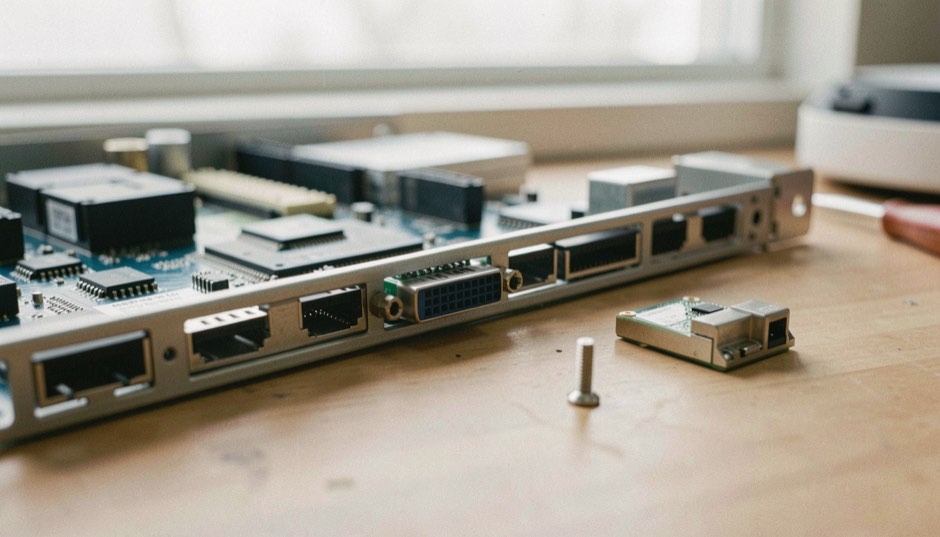
The card electromechanical connector, the long slotted socket on a workstation board, decides three things before any protocol is discussed. First, the mechanical width: slots are built x1, x4, x8 and x16, and a card physically seats only in a slot at least as wide as its edge connector. Second, the electrical width, which is a separate matter: a x16 socket may be wired for fewer lanes, so the number printed on the slot and the number the link trains to are read in two different places, the board silk and the motherboard manual. Third, power: the slot supplies the card's baseline draw, up to seventy five watts for a full size card under the card electromechanical figures, before any auxiliary lead is added.
On a rig that vibrates, the retention tab and the screw through the bracket are not cosmetic. A card that walks a millimetre out of its socket is a mechanical failure before it is an electrical one, and it produces the most confusing symptom of all: a link that trains some days and not others.
What changes when the link moves into an M.2 module?
The M.2 form factor puts the same lanes on a card twenty two millimetres wide, held by a single screw and a standoff. The name carries the size: 2242, 2260, 2280 and 22110 give the length in millimetres, and the key notch decides which signal sets the socket may carry. A B key and an M key are not interchangeable, because the notch is a mechanical filter on an electrical question. Storage modules, wireless cards and small capture devices share the outline while answering to different pinouts.
For a ground station the trade is density against serviceability. A module on a standoff is quicker to mount and easier to shake loose; a card in a slot is heavier, better held and better cooled. Neither is a detail when the recorder rides in a case that gets carried across a site twice a day.
What does a cabled link add?
Sometimes the endpoint leaves the board entirely and the lanes travel over a cable assembly. The physics is the same and the budget is not: every connector pair and every metre of copper spends margin, so cable length is a compliance parameter rather than a convenience. Where a trace or a cable spends too much, a retimer restores the eye at the far end. It is the same arithmetic a tether performs on altitude: the medium always collects its share.
What does a compliance figure actually prove?
A product that passed a compliance workshop passed a defined set of tests on a defined day, on a defined fixture. The programme that runs those workshops and keeps the integrators list is useful and narrower than most marketing suggests: it certifies that a sample met the specification once, under stated conditions. It is the same distinction the radio note drew between a printed range and a working day.
The document the tests converge on is the receiver eye diagram: thousands of bit periods drawn on top of each other at the receiver's pins, after the channel has done its work. The mask in the middle is the keep out zone the waveform must not touch; the opening that remains is the margin the link has left. Read that way, an eye diagram is to a wired link what a fade margin is to a radio one: the number that decides whether the working day survives.
What should a crew ask before trusting a capture chain?
Six questions, all mechanical or all measurable. Which mechanical form carries the link. Which electrical width sits behind it. Which generation the two ends agree to train at. Whether the module's key and the socket's key match. What the cable length costs the margin. And whether a compliance record exists for the parts in the chain, with its date and its scope. A chain that answers those six on paper will usually answer them on site; one that cannot will find the gap during a job, the way a radio link finds its missing margin at the working distance rather than on the bench.
The airborne half of this question, the link budget that carries the picture to the ground in the first place, is worked through on the radio link field note. The reference this note leans on for the link itself is the public PCI Express article, read the day this page was filed, with the same rule as everywhere else on this site: a figure is only written down with the conditions attached to it.