Fuel Transfer Geometry vs Camera Station
How fuel moves between two aircraft in flight, read beside the station-keeping geometry a tethered camera platform must hold over a fixed site.
Two aircraft flying in close formation transfer fuel through a hose or a boom, and the receiving aircraft holds a position defined by the tanker, not by the ground. A tethered camera platform faces the inverse problem: it holds position over a fixed point on the ground while wind, tether tension and payload weight act on it. Both cases reduce to the same question, which is how long a moving body can stay inside a small box of airspace, and what corrections keep it there.
The comparison is useful because the numbers are published on both sides. Tanker crews work to separation minima measured in feet and closure rates measured in knots. Camera platform operators work to station-keeping tolerances measured in meters and drift rates measured in meters per second. Reading the two sets side by side shows where the physics is shared and where the procedures diverge.
What does fuel transfer between two aircraft actually require?
Aerial refueling is a controlled rendezvous followed by a controlled contact. The tanker flies a stable track at a constant altitude and airspeed, typically between 250 and 320 knots true airspeed for a boom-equipped tanker at medium altitude. The receiver approaches from a pre-briefed position, usually astern and below, and closes at a rate of a few knots, not a few tens of knots. Closure rate is the parameter that matters: a 2-knot closure over 50 feet of remaining distance gives the receiver roughly 15 seconds to correct before contact.
For probe-and-drogue, the receiver flies a probe into a basket trailing on a hose. The hose is flexible, so the basket moves in the tanker's wake, and the receiver must track that movement. For a flying boom, the boom operator in the tanker flies the rigid boom into a receptacle on the receiver, which means the receiver only has to hold position, not steer a probe. The two methods therefore place the tracking task on different crews. Detailed descriptions of both methods, the aircraft that use them and the standards that govern them are collected under air-to-air refueling operations, which covers boom and drogue hardware, tanker fleets and mission planning.
Contact itself is a mechanical event. A nozzle seats in a receptacle or a probe seats in a basket, and a valve opens. Fuel then moves under pressure from the tanker's tanks to the receiver's tanks. Transfer rates are quoted per system: a flying boom can pass fuel at rates on the order of 1,000 gallons per minute, while a single hose-and-drogue pod typically passes a few hundred gallons per minute. The receiver's fuel system must accept that flow without overpressuring, which is why receivers have specified maximum receive rates.
How does a tethered camera platform hold station over a site?
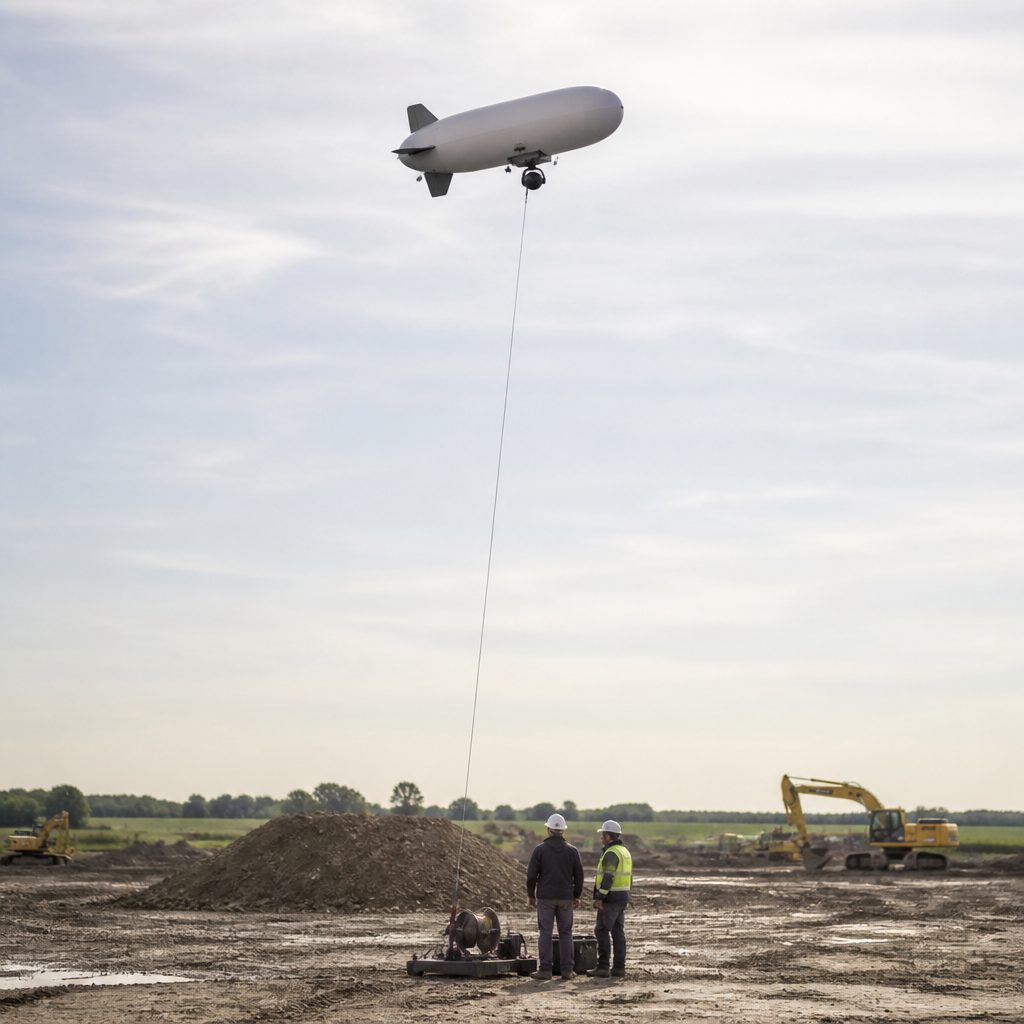
A tethered camera platform is a lighter-than-air or aerodynamic body held by one or more lines to a ground anchor, carrying a camera at a known height. It does not fly a route. It holds a position, and the position is defined relative to a point on the ground, not relative to another aircraft.
Station-keeping for such a platform is a balance of four forces: buoyancy or lift, weight, aerodynamic drag and tether tension. In steady wind, the platform settles downwind of the anchor at an angle determined by the ratio of drag to lift. A 10 mph wind acting on a 3-meter-diameter balloon with a drag coefficient near 0.5 produces a drag force on the order of 10 newtons, which a tether rated to a few hundred newtons absorbs without difficulty. The platform's horizontal offset from the anchor is then the tether length times the sine of the tether angle from vertical.
That offset is the number a photographer cares about, because it sets the camera's ground position. If the tether is 100 meters long and the wind holds it at 20 degrees from vertical, the camera sits about 34 meters downwind of the anchor and about 94 meters above it. Changing the wind speed changes the angle, which moves the camera. The operator cannot command the platform to a new position the way a tanker pilot commands a heading; the operator changes tether length, adds a tail or a kite surface, or waits for the wind to shift.
Where do the two problems share the same geometry?
Both problems are about holding a body inside a tolerance box while a disturbance acts on it. For the receiver aircraft, the disturbance is the tanker's wake and its own thrust response; the tolerance box is measured in feet of vertical and lateral separation. For the tethered platform, the disturbance is wind shear and gust; the tolerance box is measured in meters of horizontal drift and in degrees of camera pointing error.
The correction authority differs. A receiver aircraft has engines, control surfaces and a pilot or autopilot that can respond within a fraction of a second. A tethered platform has no propulsion at all in the simplest configuration; its only control inputs are tether length, winch tension and aerodynamic trim. This is why tethered platforms are used in light and steady wind, while aerial refueling is practiced in turbulence and at night.
The measurement problem is also shared. A tanker crew needs to know the receiver's position to within a few feet, and uses visual references, formation lights and, on some aircraft, a refueling rendezvous radar or a camera system. A camera platform operator needs to know the camera's position to within a few meters, and uses a laser rangefinder, a GPS receiver on the platform, or a surveyed ground reference. In both cases the accuracy of the position fix sets the accuracy of the operation.
What limits each operation in practice?
For aerial refueling, the limits are structural and aerodynamic. The receiver must be able to fly slowly enough to match the tanker without stalling, which sets a minimum tanker speed and therefore a maximum receiver weight for a given configuration. The boom or hose has a maximum extension and a maximum load. Wake turbulence from the tanker sets a minimum safe approach path. Weather sets a minimum visibility for visual contact.
For a tethered camera platform, the limits are wind and airspace. Most small tethered balloons are rated to a maximum wind speed between 15 and 25 mph, above which the tether angle becomes too large and the platform becomes unstable. Tether length is limited by weight and by the strength of the line. Airspace is limited by regulation: in the United States, a moored balloon above 150 feet requires notification to the FAA, and operations near airports require coordination.
How is each operation planned before it starts?
Aerial refueling is planned as a timed sequence. The tanker and receiver have an assigned rendezvous point, an altitude block, a time on station and a fuel offload quantity. The planning uses standard NATO procedures, including ATP-56, which defines the rendezvous geometries and the communication procedures. The receiver arrives with a known fuel state, takes on a known quantity, and departs on a known heading.
A tethered camera platform operation is planned as a site survey. The operator measures the wind at the intended height, checks the tether angle at that wind, computes the resulting camera offset, and selects a tether length that places the camera over the target. The operator also checks the airspace, the anchor point and the recovery procedure. The plan is static in a way the refueling plan is not: the platform does not travel, so the geometry is fixed once the wind is known.
The two operations meet at one point, which is the value of a precise position. Fuel moves because two aircraft agree on where they are relative to each other. A photograph is made because a camera and a site agree on where they are relative to each other. The instruments differ, the tolerances differ, and the crews differ, but the underlying requirement is the same. The same question is worked through in ABAP syntax basics.